
Find Who Owns an Ottawa County Property
Ottawa County's public tools support a clean address-to-owner search. Grab the PIN right away. Carrying that parcel identification number through every step keeps similarly named streets and mailing-city labels from pointing you toward the wrong local unit.
- Enter the house number and street name in the Ottawa County Real Property Search. Open the matching result and confirm its Property Address, PIN, Government Unit, and Taxing Unit.
- Read Owner Name 1, and Owner Name 2 when populated, under Owner Identification. Do not substitute the separate Tax Payer Identification fields.
- Check the displayed Local Unit Update date. The named city or township supplies owner and assessment changes, so this date is the practical freshness marker.
- Search that PIN or owner in the Ottawa Register of Deeds index. Compare the newest deed’s grantee, record date, legal description, and parcel number to the property card.
- If the grantee is an LLC, trust, or estate, retain the entity name exactly as recorded and use the appropriate Michigan entity, probate, or fiduciary record only for additional context.
Read Owner Name 1 Before Taxpayer Identification
The county result splits ownership into labeled blocks: Parcel Identification, Owner Identification, and Tax Payer Identification. Owner Name 1 is the field that answers who owns the property on the roll. Owner Name 2 may add a co-owner. The taxpayer block concerns billing only. It can be blank or name whoever handles the tax bill, but it never replaces the ownership block.
The card also separates two addresses. Property Address is the situs, fixing the parcel's place. Mailing Address shows where the owner's correspondence goes, and it can differ when the property is rented, entity-held, or managed from elsewhere.
- Owner of record
- The person or entity shown in the local assessment roll’s Owner Identification section.
- Vesting
- The way title is held and stated in the deed, including the named grantee and any ownership language.
- Grantee
- The party receiving an interest under the recorded deed.
- Situs and mailing address
- The property’s physical location and the separate destination for owner correspondence.
The Ottawa Parcel Card Keeps the Clues Together
A county sample property summary lays everything in one place. The PIN, property address, governmental unit, owner name, mailing address, Local Unit Update, values, and legal description all appear together on a single record.
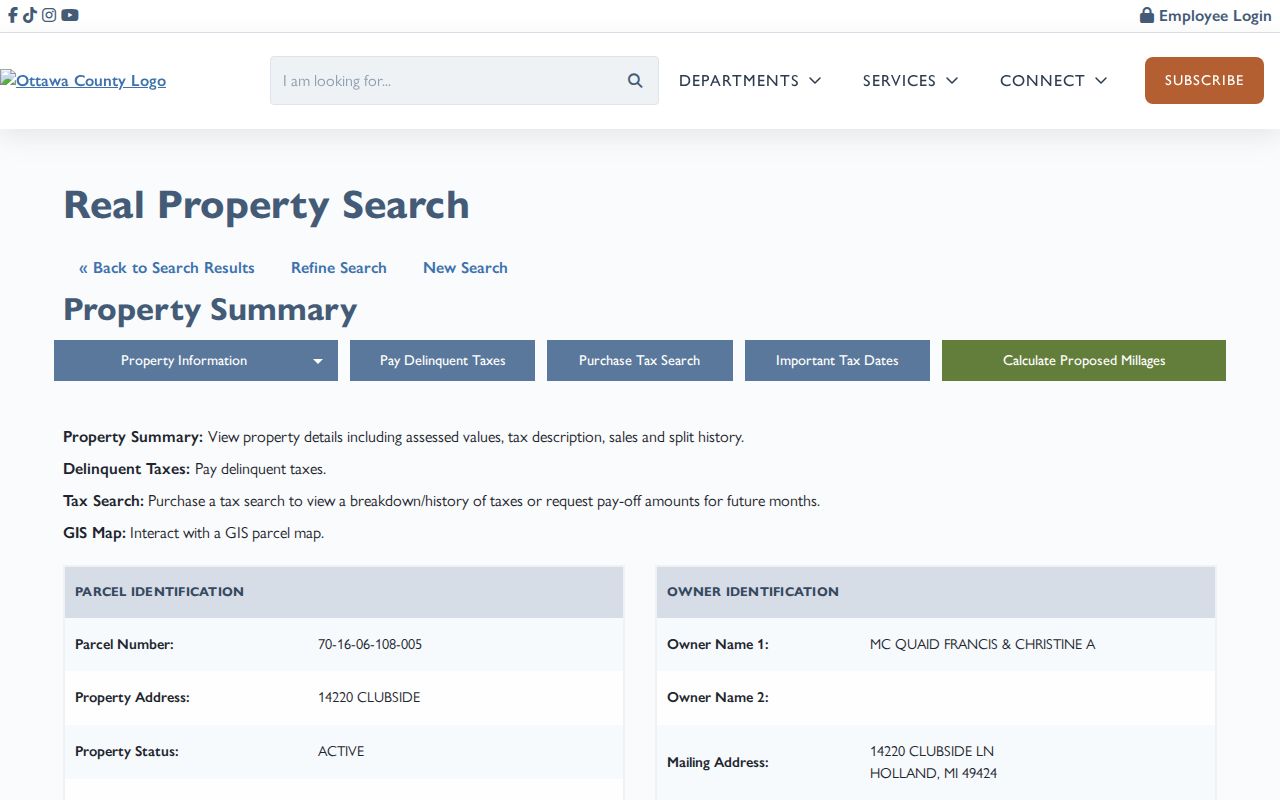
The example doubles as an identity check. Its tax description cites a condominium master deed and subdivision plan. Those references tie the roll entry to the recorded instruments.
Use Ottawa’s Local Unit Update as the Freshness Test
"Current" on the county roll has a catch. It means current as of the city or township's latest upload, not necessarily the day of a closing. Ottawa publishes local-unit dates because its 17 cities and townships maintain the underlying owner and assessment changes. No fixed countywide lag exists.
Practical comparison. If a deed recorded after the Local Unit Update date names a new grantee, the deed may be newer than the roll. If the deed predates the update but the names still conflict, contact the local assessor and Register of Deeds to check indexing or processing.
Which Ottawa County Source Answers Which Owner Question
No single screen proves ownership. The roll answers who the local unit carries as owner. The deed index answers the latest recorded transfer, and GIS pins the name to the right parcel geography.
| Source | Owner Info It Gives | Access |
|---|---|---|
| Real Property Search | Owner Name 1/2, mailing address, PIN, unit and update date | Free county portal |
| Register of Deeds index | Parties, deed type, record date, document number, liber/page and parcel | Index free; images $1 per page plus applicable fee |
| Michigan business registry | Public filing context for an LLC or corporation named in the land record | State portal |
| Ottawa parcel GIS | Roll owner and situs tied to mapped parcel geometry | Free county viewer |
A roll owner may be a person. It may equally be a company, a trustee, or an estate. No single source proves who occupies the home. It also cannot prove who holds beneficial control behind a trust or business. Preserve the exact recorded names rather than converting them into assumptions about residents.
Confirm the Roll Name with Ottawa’s Newest Deed
The Ottawa Register of Deeds search is flexible. Party name works. So do liber and page, parcel number, instrument number, or a date range with document type. Results identify Party 1, Party 2, record date, document number and type, liber/page, parcel number, and related document.
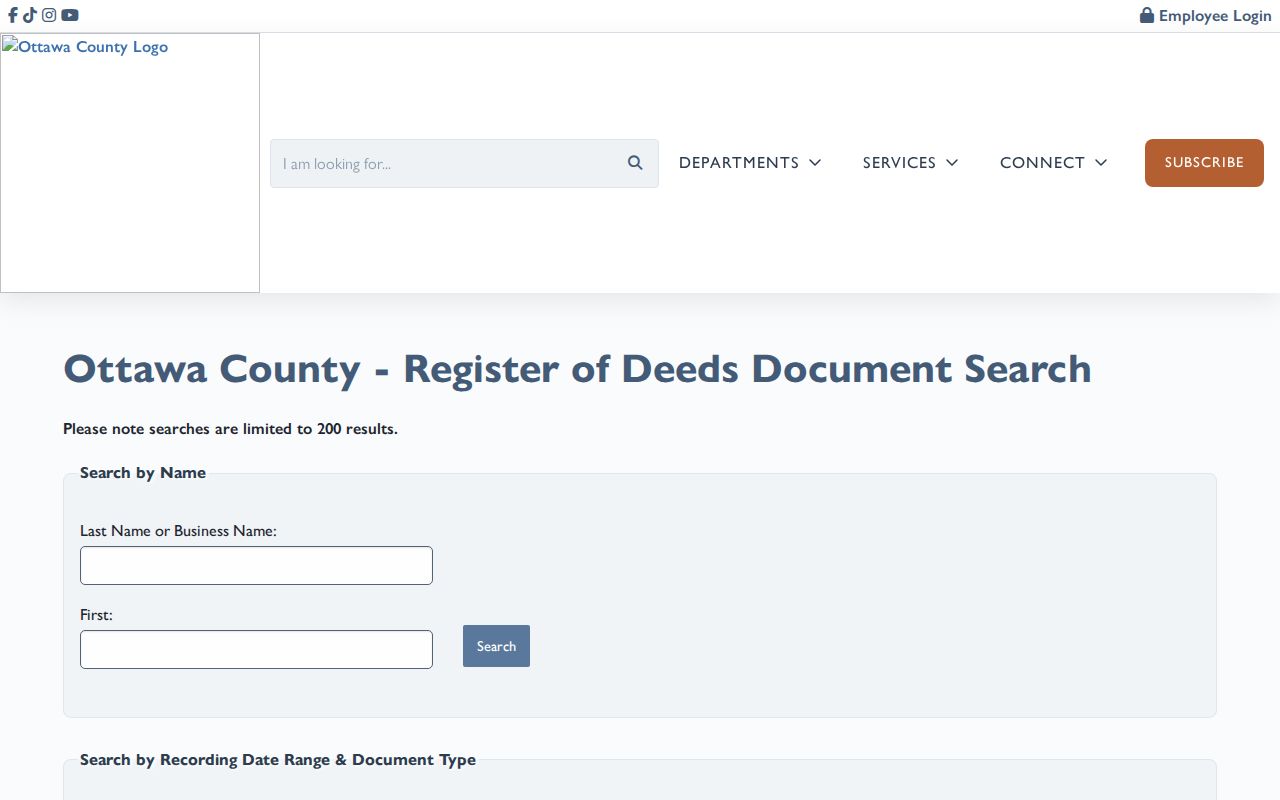
Open the latest plausible deed. Compare the grantee and the legal description, not just a familiar surname. The free index caps results at 200. Viewing, printing, or saving an image costs $1 per page plus the applicable convenience or technology charge, and the county notes that this public search is not a title search.
A Mailing City Does Not Fix the Government Unit
An address labeled Holland or Zeeland can sit in a township rather than the city. The postal city can mislead. Local assessors supply the ownership updates. After an address search, check Government Unit and Taxing Unit on the parcel card instead of routing a question by postal city alone. The parcel's PIN and its GIS location make the stronger match.
This matters most after a recent ownership change. Calling the city assessor about a parcel maintained by Holland Township or Zeeland Charter Township will not fix the roll. The governmental-unit field points to the correct local office.
When the Named Owner Is a Trust, Estate, or LLC
Record the complete owner name first. Search variants exactly as they appear. Ottawa's assessor owner search exposes only an Owner Last Name box. Punctuation, spacing, or a label like "trust," "trustee," or an estate tag can swing the results. The deed states vesting best.
A Michigan business filing can identify the public record behind an LLC grantee, while probate or a fiduciary deed explains an estate transfer. Those secondary records add context. They do not replace the parcel-specific deed. Ottawa's genealogy death search reaches deaths recorded from 1867 and may explain an older fiduciary transfer, but a death record alone never establishes title.
Ottawa’s Property Fraud Alert Watches a Recorded Name
Ottawa County publicized its free Property Fraud Alert in winter 2025. Enroll a name, and a phone, text, or email notice follows whenever a document is recorded in it. Enrollment by phone is 1-800-728-3858. The alert is a monitoring layer, not proof that a filing is valid and not insurance against title defects.
An unfamiliar alert deserves a closer look. Compare the document number in the deed index. Contact the Register of Deeds at 616-994-4510. Skip the unsolicited paid "deed copy" letter, since the county can identify the actual record and its official copy cost.
What an Ottawa County Owner Lookup Cannot Establish
A public owner field answers only part of the question. It does not list every occupant. It cannot prove who holds beneficial ownership behind a trust, estate, or business entity. It also cannot resolve competing ownership interests or guarantee marketable title. A single parcel can carry mortgages, easements, liens, probate events, or related recorded documents. Those demand separate review of the deed records. For a transaction or a legal dispute, a professional title search may be appropriate. Advice from a qualified Michigan professional may also help.
Lawful use. Use Ottawa County owner information for legitimate property diligence, boundary questions, record correction, or civic transparency. Never use public records to stalk, harass, threaten, or harm a person.