
Run an Ottawa Property Search
The Ottawa County Real Property Search offers three entry points. Owner mode keys on a last name. Optional first-name help and active or inactive parcel filters refine it. Parcel mode takes the segmented county PIN. Address mode wants a house number plus street name. There is no city or ZIP filter. The Government Unit returned with the match is the real jurisdiction check.
- Choose address when a street location is known. Enter the number and street name, then compare all matches.
- Open the correct active parcel. Confirm the government unit, site address, and full PIN before reading owner data.
- Review Owner Name 1, Owner Name 2, taxpayer identity, mailing address, and Local Unit Update as distinct fields.
- Use the PIN in the deed index, tax-history service, and GIS viewer. This reduces false matches caused by names or postal cities.
- Order the recorded image or certified copy only after the index details identify the right instrument.
Inactive parcels matter when a split or combination retired an old PIN. If a known address vanishes, search both statuses. Split History and parent-parcel clues then reconnect you to the right record.
Choose Ottawa's Best Search Key
Every search key has a weakness. Address is fastest for a single occupied site, though a mailing city can mislead you about the local government. Owner search may surface several parcels, but trusts, estates, and businesses must match the recorded spelling exactly. Once verified, the PIN is the strongest key.
| Official field | Use it for | Format or limit |
|---|---|---|
| Owner last name | Person, trust, estate, or entity holdings | Try spacing and name variants; choose active/inactive |
| Parcel number | One exact tax parcel | 70-##-##-###-###; keep leading zeros |
| House number and street | A known physical site | No documented city or ZIP field |
The form still expects a house number, even for street-wide research. Use the GIS map to hop between neighboring parcels instead. There is no countywide street-only search.
See Ottawa's Three Search Modes
The official real-property form makes owner, parcel, and house/street searches visible on one screen.
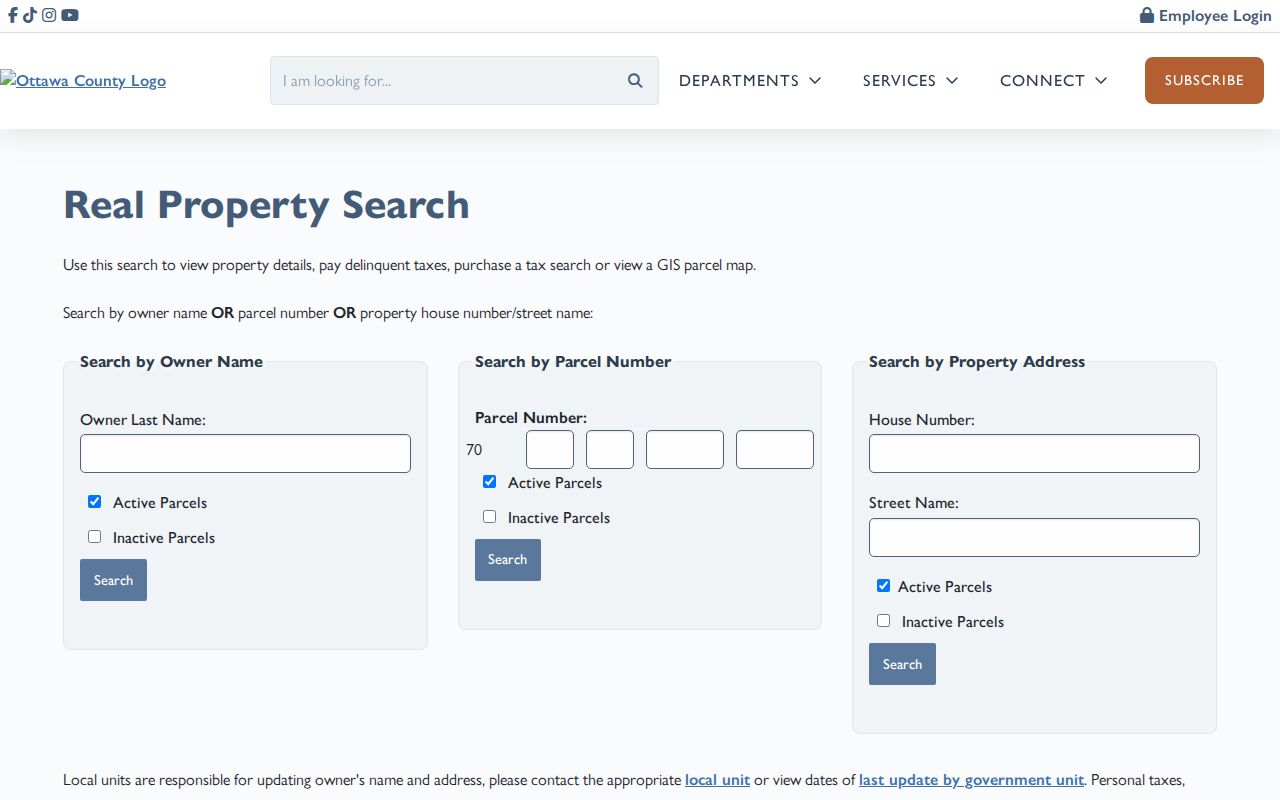
The active and inactive toggles on the form matter when a parcel was split, combined, or retired. Write down your search terms. That way a later check repeats cleanly.
What Ottawa Search Results Reveal
A matched Ottawa parcel summary bundles identification, ownership, taxpayer, valuation, and history into one screen. Labels deserve a close read. Owner Name 1 is the roll's primary owner field. Taxpayer Identification may name a different recipient. Situs marks the land's street location; the mailing address shows where notices go. Government Unit names the city or township behind the local update.
| Owner fields | Owner Name 1 and 2, taxpayer name, mailing address |
|---|---|
| Parcel identity | PIN, property address, status, government unit, class |
| Annual values | Assessed, state equalized, capped, and taxable values; PRE |
| Tax description | Legal text, plat or condo references, acreage when supplied |
| History tabs | Sales dates and amounts, split history, linked parcel report |
Assessment value is not a current sale appraisal. GIS geometry is not a boundary survey. Owner Name 1 does not prove anyone occupies the address, and a parcel summary is never a title opinion. Each limit points you to the follow-up record you actually need.
Date Ottawa's Owner Result
Ottawa County warns that local units supply the owner and address data. Its Local Unit Update table lists the latest update date. It covers every city, township, and village. Set that date beside the recording date of a recent deed. Was the deed recorded after the update? The prior owner may still sit in Owner Name 1. The table makes the differing local schedules visible at a glance.
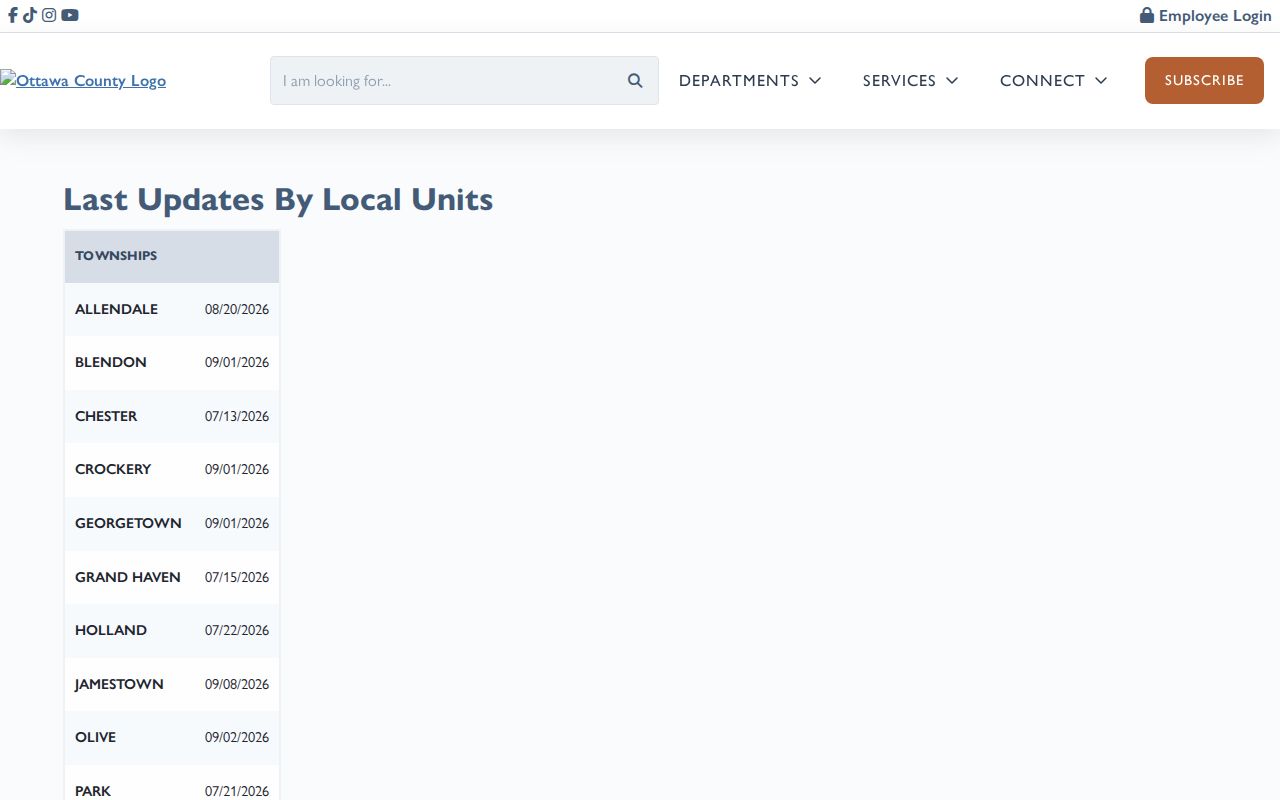
For the latest correction, contact the assessor for the Government Unit on the parcel. Ottawa County Equalization standardizes and compiles the data. It does not replace that local assessor.
Freshness check. Compare closing date, deed recording date, and Local Unit Update before treating an owner field as current.
Carry the PIN Into Deeds
Once the property search hands you a PIN, take it straight to the Ottawa Online Deeds Search. The index accepts several lookup routes: parcel, party, recording date, document type, liber/page, or instrument number. Parcel mode works best with a PIN in hand. It narrows results to one piece of land. Each hit lists the record date, the parties, and the document number and type. The liber and page, the parcel, and any related-document reference appear as well.
A current deed tells you who took title as grantee. A mortgage is different. It secures a loan without moving ownership. Its discharge or release should be matched against the instrument it retires. Searching the index is free, though results cap at 200. Images run $1 per page plus the portal fee. Document numbers containing a U may have no image online at all.
For certified copies or deeper digging into older Ottawa County property records, the Register of Deeds handles requests. The recording office sits in Room 146 at 12220 Fillmore Street in West Olive. A Research Library operates from Room 115 at 414 Washington Avenue in Grand Haven.
Decode Ottawa Condo Results
A condominium unit can trail more references than an ordinary address result. Ottawa's sample card for Clubside Villas at Macatawa Legends ties a unit PIN to a master deed document and a subdivision plan. The card lists a tax description and an active date. It also shows parent context, value history, and a PRE percentage. Each one answers a different question.
Use the unit PIN for the current tax parcel. Use the master deed reference for the condominium's governing land instrument and plan. When a unit was recently created, Split History links it back to the parent parcel. Never substitute the street address for the recorded legal description.
- Master deed
- The recorded instrument establishing the condominium.
- Subdivision plan
- The recorded drawings and unit layout tied to the master deed.
- PRE
- Michigan's Principal Residence Exemption percentage on the tax record.
Recover a Failed Ottawa Search
A blank result is a prompt to switch keys, not proof the record is missing. Check spelling first. Also review leading zeros, active and inactive status, and government unit. Trusts and companies may hide under formal indexed names. A renamed street or a fresh split can force a prior-parcel or legal-description search instead.
- Use Property Mapping to identify the site and nearby parcel numbers.
- Ask the local assessor about an address or owner update.
- Search the deed index by party, parcel, liber/page, or instrument.
- Use the plat search for subdivision and lot clues.
- Visit the Register's research room for older books or images absent online.
For county administrative records outside any dedicated system, Michigan FOIA permits a written request describing the record. The public body usually answers within five business days and may take one ten-business-day extension. Court records follow separate court access rules.
Compare Ottawa Search Routes
Pick your route by what you already know. An address gets you to one parcel fast. A parcel number matches exactly across every Ottawa County system. Owner names pull related holdings together, though spelling trips them up. Deed party searches track anyone named in recorded documents. They catch more than whoever sits on the current tax roll.
| Search Key | Best For | Where It Works | Watch Out |
|---|---|---|---|
| Address | Find one physical site | Property search and GIS | Postal city may not equal government unit |
| Owner name | Find parcels listed to a person or entity | Property and deed searches | Trust, estate, company, and spelling variants |
| Parcel number | Match one tax parcel | Property, deed, tax, GIS | Keep all segments and leading zeros |
Not a title search. An Ottawa County property search locates public records but does not guarantee clear title. A title professional examines the full chain and exceptions.
Ownership is the whole question? Head straight to who owns this property. For the rest, Ottawa County offers deed records for the chain of title, tax records for bills and values, and parcel maps for the lay of the land.