
Inside Ottawa County Tax Records
Ottawa County tax records keep the valuation roll apart from the bill and payment account, and each layer answers a different question. The roll says what a parcel is worth. The miOttawa property summary posts annual SEV, taxable value, and PRE/QA exemption, while local units issue the current summer and winter bills. Delinquent prior-year taxes go to the Treasurer.
| Record field | What it establishes | Custodian |
|---|---|---|
| SEV | Equalized assessment | Local assessor and County Equalization |
| Taxable value | Capped base used with millage | Local assessment roll |
| PRE/QA | Displayed exemption percentage | Local assessor |
| Summer and winter tax | Billed tax by levy period | City, township, or village |
| Delinquent balance | Prior-year unpaid tax | Ottawa County Treasurer |
Michigan assesses at 50% of true cash value. Proposal A caps can hold taxable value below SEV. The bill then applies millages and special assessments, and it never states a sale value.
Ottawa Tax Search Fields
The miOttawa Real Property Search takes an owner last name, a segmented PIN, or a house number and street, with inactive parcels addable for split or combined history. Active parcels load by default. There is no city or ZIP field.
| Search key | Input shown | Best use |
|---|---|---|
| Address | House number and street | Known site |
| Owner | Owner Last Name | Multiple holdings |
| Parcel | 70 plus 2-2-3-3 digits | Exact account |
Check the Government Unit and Taxing Unit fields. A Holland, Zeeland, or Grand Haven mailing city does not prove which jurisdiction assesses the parcel.
Ottawa's Paid Tax History
The parcel summary and GIS are free. The purchased Ottawa County Tax Search adds historical summer and winter detail, delinquent amounts, and a future-month payoff request, along with a fifty-cent search fee and a fifty-cent technology fee. That totals one dollar.
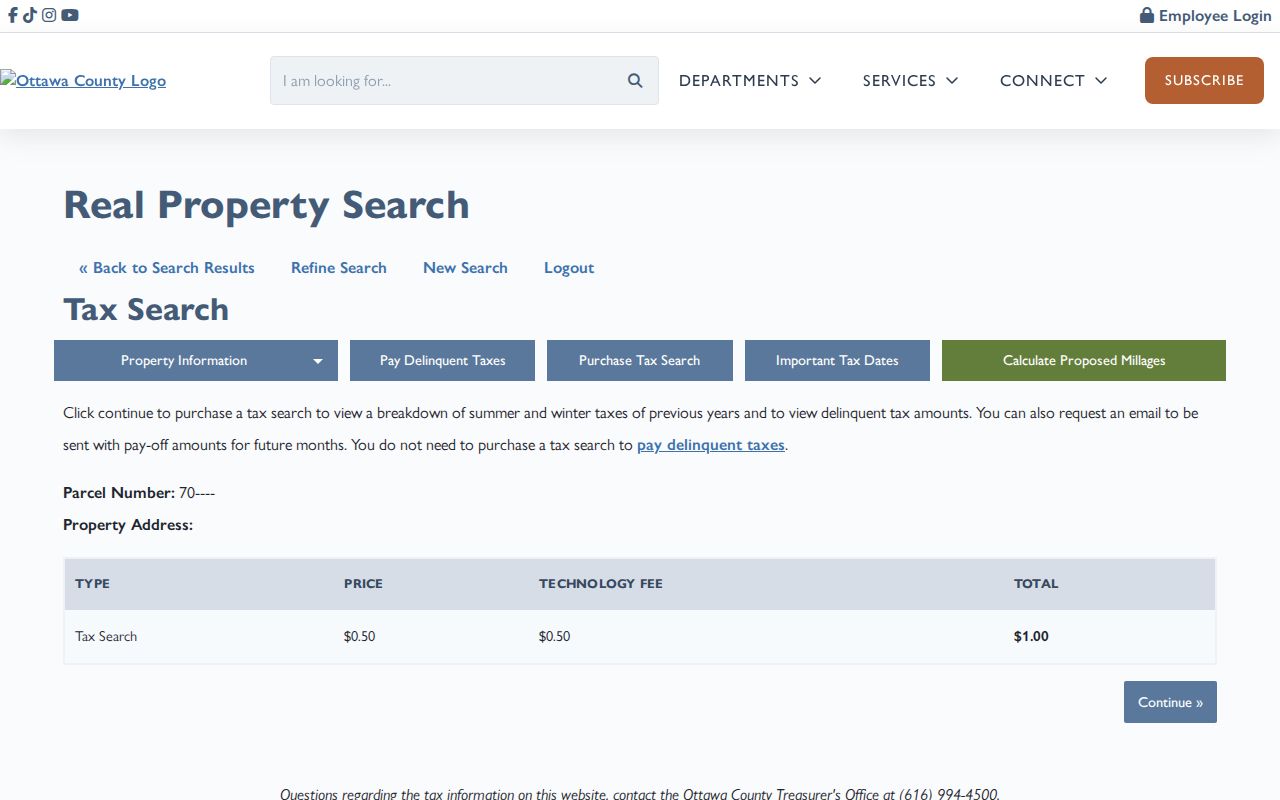
The paid screen keeps the tax account separate from the free parcel summary. Save the PIN and tax year.
Look Up an Ottawa Tax Bill
Local units bill real property on July 1 and December 1, and prior-year unpaid amounts return delinquent to Ottawa County on March 1. That handoff decides the right office.
- Find the PIN and confirm its Taxing Unit.
- Use that local unit for the current bill.
- Use the County Treasurer for prior-year delinquency.
- Check SEV, taxable value, and PRE/QA on the parcel summary.
- Verify any foreclosure date with the Treasurer.
- Assessed value
- The local value before equalization.
- Millage
- A tax rate applied to taxable value.
- Principal Residence Exemption
- Eligible relief from local school operating millage.
- Tax lien
- A government claim tied to unpaid tax.
Ottawa Property Tax Exemptions
Michigan's Principal Residence Exemption can remove up to 18 mills of local school operating tax from an eligible principal residence. Form 2368 goes to the city or township assessor. The parcel card merges the display as PRE/QA. Confirm the type locally. Qualified agricultural, disabled-veteran, poverty, and industrial-facility exemptions follow separate rules. PRE denial routes depend on whether the local assessor, the county, or Treasury acted. Never infer eligibility from a prior owner's record.
Note: A transfer can change taxable-value and exemption treatment even when the parcel looks unchanged.
Ottawa Delinquent Tax Records
County records can show delinquent sums. Foreclosure-stage details appear there too. Ottawa has scheduled 2026 foreclosure auctions for August 26, September 25, and October 30, so verify the live notice before relying on those dates.
The Treasurer answers at 616-994-4501 in West Olive and 616-846-8357 in Grand Haven. Both offices keep weekday hours from 8 a.m. to 5 p.m., with Grand Haven closing from 1 to 2 p.m., and counter staff can confirm a payoff. Use mail, email, or the counter when checkout fails.
Offline Ottawa Tax Record Access
For roll changes, call Ottawa Equalization at 616-738-4826 or reach the local assessor for the parcel. Questions about delinquent accounts go to the Treasurer at treasurer@miottawa.org. Include the PIN, the tax year, the record you want, and your preferred copy format with each request.
Non-court county records that are not online can be sought through a written Michigan Freedom of Information Act request. The body normally answers within five business days and may take one written ten-business-day extension. Search, review, redaction, copy, and mailing charges can apply where allowable.
Contest an Ottawa County Assessment
The March Board of Review is the usual first local route. It hears value and classification issues. Holland's 2026 notices went out February 20. Appointments run March 10 through 13. Zeeland begins hearings the Tuesday after the first Monday in March and asks for a separate form per parcel, three copies, and support such as an appraisal or comparable sales.
Appeal window. Check the local Board of Review calendar each year, then follow current Michigan Tax Tribunal instructions for any further appeal.
A Board handles value and classification disputes, not millage. Tribunal timing differs by property class. Current instructions control.